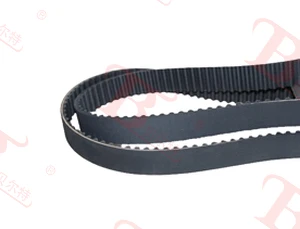
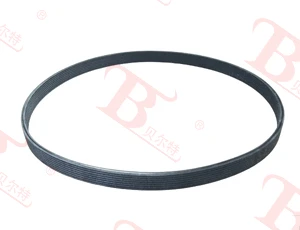
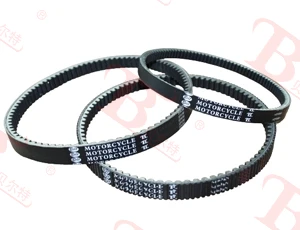
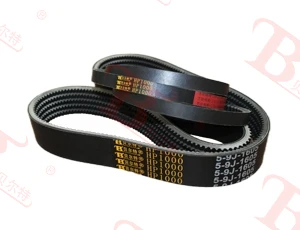
As a specialized raw edge belt manufacturer, Wuxi Belt understands that the efficiency of your power transmission system is directly tied to the integrity of your drive components. A raw edge belt is engineered for high-friction applications, offering superior power transmission through its unique construction—where the sidewalls are cut to expose the friction-enhancing fabric and rubber. While this design is highly efficient, maximizing its potential requires a strategic approach to maintenance, alignment, and environmental control. This guide serves as a comprehensive resource for engineers, maintenance supervisors, and procurement managers to ensure their power transmission systems operate at peak performance levels throughout their operational lifecycle.
Unlike wrapped belts, the raw edge belt provides a higher coefficient of friction between the belt sidewalls and the pulley grooves, which allows for increased power capacity and better heat dissipation. Because the sides are not covered by a protective fabric layer, the belt can bend more easily around smaller pulley diameters, reducing internal energy loss and heat accumulation during operation. This is critical in high-speed industrial machinery where heat is the primary enemy of rubber compounds.
To maintain these performance advantages, users must strictly adhere to the manufacturer's specifications when selecting a belt. Factors such as the belt’s pitch, angle, and cord composition must match the pulley profile exactly. Furthermore, the environment must be considered; since the exposed rubber on a raw edge belt is more sensitive to oils, solvents, and environmental contaminants than wrapped variants, proper shielding or housing is often necessary in harsh production environments.
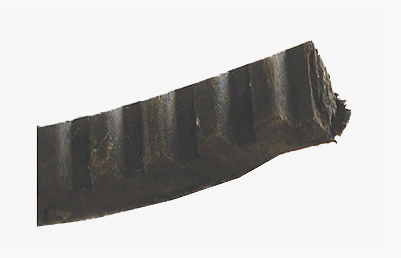
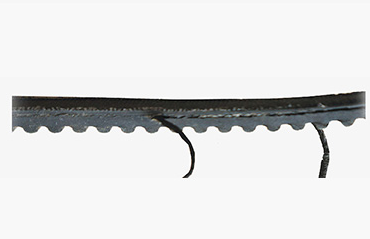
A snapped raw edge belt is frequently caused by severe over-tensioning, which places undue stress on the inner structure and tensile cords. When the internal cords are constantly stretched beyond their limit, they begin to lose their structural integrity, leading to a sudden, catastrophic failure. Additionally, if external debris—such as metal fragments, grit, or process dust—enters the drive system, or if internal machine components shift due to vibration, they can physically cut or crush the belt.
Diagnostic Clues: Sudden snaps, jagged tears, or visible structural snapping after high-load operations are clear indicators of mechanical overload or interference.
Professional Solutions:
Always calibrate the tension to the manufacturer's recommended range using a tension gauge to prevent structural overload.
Perform a thorough, recurring inspection of the wheel system to ensure all parts are secure, tightened, and correctly positioned.
Clear the drive path and install protective guards or housing for any foreign objects before installing a new raw edge belt.
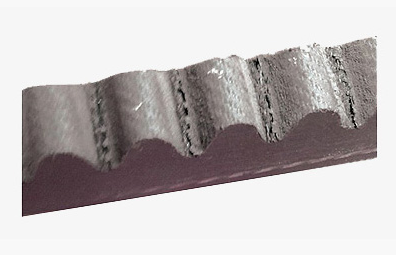
When you notice cracks at the base of the belt teeth, it is often a diagnostic sign that the belt has been used beyond its intended service life or subjected to excessive heat. Furthermore, improper tension—whether the belt is too loose or too tight—accelerates this fatigue, causing the rubber compound to lose its elasticity and develop fissures under the stress of pulley bending. As the belt bends over the pulley, the tooth base undergoes alternating cycles of compression and tension; if the rubber has hardened due to heat, it cannot absorb these forces, resulting in cracks.
Diagnostic Clues: Visible cracking at the base of the teeth, often accompanied by hardening, discoloration, or a "dry" rubber texture.
Professional Solutions:
Inspect cooling fans and ventilation systems to ensure the machine is operating within a safe temperature range.
Replace the belt immediately upon detecting micro-cracks, as these propagate rapidly into full failures.
Ensure tension is precisely calibrated to the system specifications and retighten all auxiliary components after the installation of a new belt.
One-sided wear is a clear indicator that the belt is tracking improperly, often due to misaligned pulleys or pulley defects. If the raw edge belt is subjected to severe vibration during operation, it may slip from the guide edges, leading to rapid degradation on a single flank. Misalignment forces the belt to ride against the pulley flange, which acts like a knife, slicing through the belt sidewall and significantly reducing its load-bearing capacity.
Diagnostic Clues: Accelerated wear on only one side of the belt, often accompanied by heavy fraying, uneven surface texture, or polished, shiny spots on the pulley sidewall.
Professional Solutions:
Check the parallelism and angular alignment of your pulleys using laser alignment tools.
Replace any faulty tensioners, bearings, or worn pulleys that may be causing the system to run unevenly.
Verify that the belt is not vibrating excessively during operation, as this is a primary symptom of a system needing mechanical adjustment.
Beyond the common failure modes, the long-term success of your drive system depends on advanced operational practices. First, implement a "soft start" protocol. Abruptly starting a machine at full speed subjects the raw edge belt to a massive torque spike, which can cause internal cord damage that isn't visible on the surface. By using variable frequency drives to ramp up speed, you distribute the load more evenly.
Second, implement a routine maintenance log. By tracking the installation date, operating hours, and tension checks for every raw edge belt, you can predict failure before it occurs. This data-driven approach allows you to replace belts during scheduled downtime rather than during peak production hours, saving significant costs in lost output.
Proactive maintenance is essential for extending the lifespan of your industrial drive system. By monitoring for signs of wear such as cracking, thermal fatigue, or misalignment, you can prevent costly downtime. At Wuxi Belt, we provide high-durability transmission solutions tailored to your unique requirements. Explore our comprehensive Products Page to find the right specification for your machinery, or Contact Our Team today for professional technical support, material selection advice, and expert guidance on your specific application challenges. We are dedicated to ensuring your machinery runs smoothly, efficiently, and without unnecessary interruption.
What is the most common cause of raw edge belt breakage?
Breakage is typically caused by extreme over-tensioning or physical damage from foreign objects or shifting system parts.
Why are there cracks at the base of my belt's teeth?
This is usually caused by excessive operating temperatures, improper tension settings, or simply using the belt beyond its recommended service life.
How can I fix one-sided wear on my belt?
One-sided wear is almost always due to pulley misalignment or pulley defects; check your pulley parallelism and replace any damaged components.
Is it necessary to replace pulleys when replacing a raw edge belt?
If your pulleys show signs of damage or wear, it is highly recommended to replace them to ensure your new belt operates efficiently and lasts its full service life.